






The reformed Decent Homes Standard: what social landlords need to plan for
The Decent Homes Standard is being rewritten for the first time since 2006, and the shape of it is now confirmed. In its policy statement of 28 January 2026, the government set out a reformed Decent Homes Standard with five criteria, a new duty on damp and mould, and a deadline of 2035 for every rented home to comply. That sounds a long way off. It is not, once you understand that it lands on top of two other reforms already in motion, and that the stock-condition work to meet it needs to start in this planning cycle. This guide explains the new standard, how it fits with everything else, and what to do now.
What the reformed Decent Homes Standard is
The Decent Homes Standard is the baseline every social home is expected to meet: a floor for condition, safety and comfort. The current version dates from 2006. Following a consultation, the government confirmed the reformed standard in its response and policy statement, both published on 28 January 2026.
Two things make this more than a refresh. First, for the first time the standard will also apply to the private rented sector, through the Renters' Rights Act 2025, so the whole of rented housing moves to one baseline. Second, the criteria themselves have been updated, including a brand new one.
The five criteria
A home will need to meet five criteria to be decent:
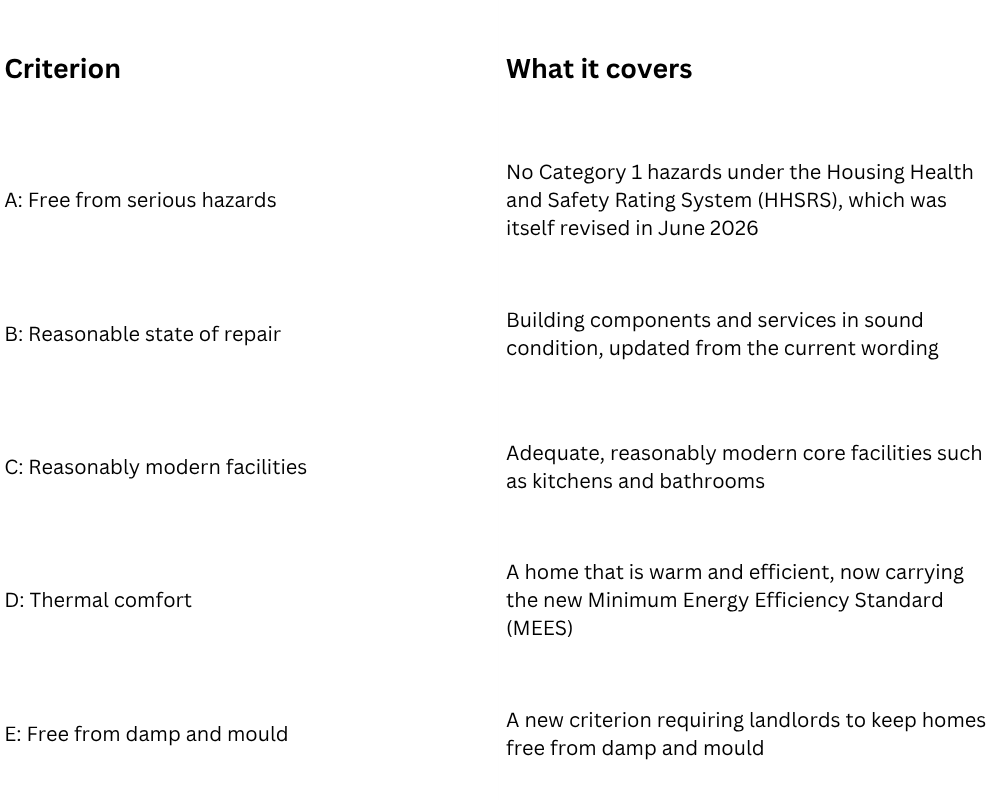
Criteria B, C, and D have been revised, and Criterion E is new. Criterion A carries over, but note the HHSRS it relies on was revised in June 2026, so the hazard assessment itself has moved.
How it fits with MEES and Awaab's Law
This is where asset leads get tangled, so it is worth being precise. Three reforms are converging, and they nest rather than compete:
- The reformed Decent Homes Standard is the overall baseline, with the five criteria above.
- The Minimum Energy Efficiency Standard (MEES) is not a separate regime sitting alongside it. MEES is how Criterion D (thermal comfort) is met, requiring EPC C by 2030. If you are planning for EPC C by 2030, you are already doing part of your reformed Decent Homes Standard work.
- Awaab's Law sets the timescales for investigating and fixing hazards, including damp and mould, once a home is occupied and a problem is reported. The new Criterion E sets the standing condition the home must be in. One is the response duty, the other is the baseline. They reinforce each other.
Plan against all three at once. The stock-condition survey that tells you a home's EPC rating also tells you its repair state, its facilities, and its damp risk. Collect it once, use it for everything.
When does it apply, and to whom?
The headline date is 2035: every rented home, social and private, must meet the reformed standard by then. In the social rented sector, the way the standard is regulated does not change. The Regulator of Social Housing will continue to hold landlords to it through its consumer standards.
The government has said it will publish detailed guidance for landlords on implementing the standard by the end of 2026. That guidance is where the finer points of phasing and evidence will land, so it is worth watching for.
A note on cost, because it frames the scale. The government's impact assessment (using 2023 data) put the cost of meeting the standard in the social rented sector at £11.3 billion in total, of which £1.8 billion is spend above and beyond existing obligations. This is a long, funded programme, not a quick fix, which is exactly why starting the planning early matters.
What to do now
2035 is roughly two stock-investment cycles away. The organisations that arrive comfortably will have used the run-in rather than waited for it. A sensible order of work:
- Run a single, good stock-condition survey that captures all five criteria at once: hazards, repair, facilities, thermal performance and damp risk. Do not survey five times.
- Map your stock against the new standard, so you know which homes are already decent, which are close, and which need real investment.
- Join up your MEES and Decent Homes programmes. The EPC C by 2030 work is the thermal-comfort criterion. Treat them as one programme with two deadlines, not two programmes.
- Get ahead on damp and mould (Criterion E). A home retrofitted for warmth is usually a home less prone to condensation, so the fabric work you do for Criterion D helps here too. Where damp is already present, deal with the cause, not just the symptom.
- Watch for the end-of-2026 guidance and fold its detail into your asset management strategy.
Preparing with your delivery partner
Meeting the reformed Decent Homes Standard is a decade-long capital and maintenance programme, and most landlords deliver it with a works partner. The pairs that make the 2035 deadline comfortably tend to agree the survey approach and data standard together, plan archetype-based solutions rather than home-by-home fixes, and sequence the work so that thermal, repair and damp measures are done in one visit where possible. Deciding this together, early, is what stops 2035 becoming a cliff edge.
This is the kind of work Axis CLC delivers for social housing landlords: whole-estate stock-condition-led programmes across refurbishment, planned maintenance and damp and mould, on the existing, occupied estate.
Next step: If you are shaping your route to the reformed Decent Homes Standard, book a call with our team, to talk through a single stock-condition approach and a joined-up programme. Related guides: EPC C by 2030: the new energy standard for social housing (Criterion D) and Awaab's Law Phase 2: what social landlords must do (the response duty behind Criterion E).
Sources:
MHCLG, "Consultation on a reformed Decent Homes Standard for social and privately rented homes: government response" and "The New Decent Homes Standard: policy statement", gov.uk, both published 28 January 2026 (consultation page); Decent Homes Standard Interim Impact Assessment (gov.uk). Current as at 21 September 2026; the policy statement is the confirmed position, with detailed landlord implementation guidance due by the end of 2026.