





EPC C by 2030 for social housing: what the minimum energy standard means for your stock
For the first time, socially rented homes in England will have to meet a minimum energy efficiency standard. The government confirmed it on 1 April 2026, and it puts a clear line in the ground: EPC C by 2030 for social housing, measured under the reformed Energy Performance Certificate system. If you run or maintain social housing stock, the planning you do in the next twelve months decides whether that deadline arrives as a milestone or a scramble. This guide sets out what the standard actually requires, the dates that matter, and the practical moves worth making now.
What has been decided
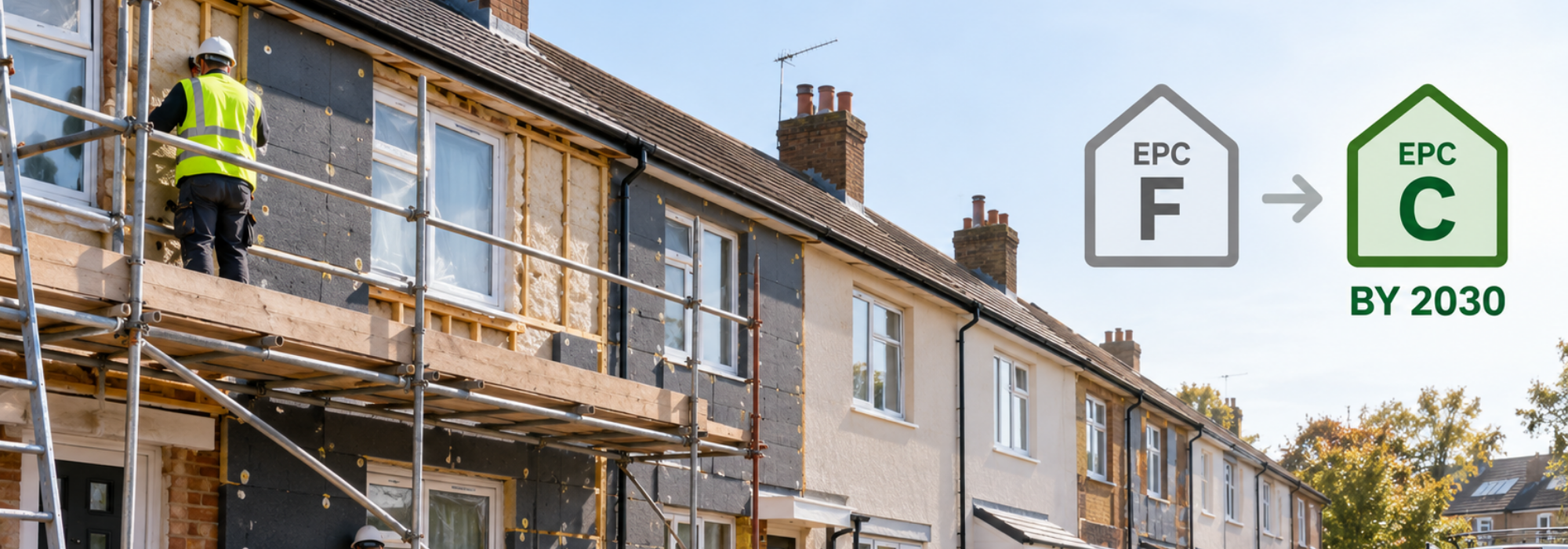
Social rented homes have never had to meet a minimum EPC rating. There has been an effective floor, just not an EPC-based one: the sector's existing requirements leave homes at roughly an EPC F equivalent. What is new is setting EPC itself as the standard to hit. The Minimum Energy Efficiency Standard (MEES) for the social rented sector does exactly that, and it was confirmed in the government's response to the Improving the energy efficiency of socially rented homes in England consultation, published by MHCLG and DESNZ on 1 April 2026.
The headline is simple. Every social rented home must reach EPC C or higher by 1 April 2030. The detail is where the useful part lives.
The dates that matter
Two compliance dates sit at the heart of the standard:
- 1 April 2030: each home must reach EPC C against one of the reformed EPC metrics.
- 1 April 2039: each home must reach EPC C against a second metric.
The reformed EPC moves away from a single score to three separate metrics: fabric performance, heating system, and smart readiness. You choose which metric to meet first. That flexibility matters, because the cheapest route to compliance will differ from one archetype to the next.
There is also a sensible bridge for work already under way. A home that reaches the current EPC C standard (under the existing energy efficiency rating, or EER, method) before 1 April 2030, with a valid certificate, counts as compliant for the life of that certificate. So the retrofit and stock-improvement plans you are already running towards EER C are not wasted; they carry you into the reformed system, and you then work towards the second metric between 2030 and 2039.
The £10,000 spend cap, and how it protects you on hard-to-treat homes
Not every home can be retrofitted to an EPC C at a sensible cost. The standard recognises that with a per-property spend exemption.
For each metric, there is a £10,000 cap on the spend you are required to make. If you spend up to £10,000 trying to reach EPC C on your chosen first metric by 2030 and the home still falls short, you can claim an exemption that runs for ten years, to 2040. The same applies to the second metric: up to £10,000, with the exemption running to 2049. A few points worth knowing:
You do not have to spend the full £10,000 for the exemption to apply. If the next measure would tip you over the cap, you are not required to fit it.
- Grant funding counts towards the cap where it improves the home's efficiency, but only money spent from 1 April 2026 onwards.
- Up to 15% of administration and ancillary costs, the cost of up to two EPCs, and the cost of PAS compliance can be counted within the cap.
- Installing or replacing a gas boiler does not count as an eligible measure, even if it nudges the score.
The cap is a mechanism to spread cost on genuinely hard-to-treat properties, not a ceiling on ambition. You can spend more where it makes sense.
How this fits the bigger compliance picture
MEES does not arrive on its own. It will be regulated as part of the reformed Decent Homes Standard, under a criterion on thermal comfort, and enforced by the Regulator of Social Housing. The Housing Ombudsman keeps its role as the route to redress for tenants. The standard also sits inside the wider £15 billion Warm Homes Plan, the government's programme to upgrade up to five million homes by 2030.
The practical read for an asset or compliance lead: energy efficiency, decency and damp and mould are converging into one planning problem. A home that is warmer and cheaper to heat is also a home less prone to condensation and mould, which is the same outcome Awaab's Law and the reformed Decent Homes Standard are pushing towards. Plan the work once, against all three, rather than three times.
What to do in the next twelve months
The 2030 deadline sounds distant. It is not, once you account for survey, procurement, funding and the sheer volume of homes. A sensible order of work:
- Get your EPC and stock-condition data straight. You cannot plan a programme against data you do not trust. Work out which homes are already at EER C, which are close, and which are the genuine hard-to-treat cases.
- Model the cheapest compliant route per archetype. Because you can choose which metric to hit first, the answer will vary: fabric measures for some, a heating-system change for others, smart-readiness for a third group.
- Sequence the measures. Insulation and fabric first where it pays, then solar, then heat pumps where the fabric supports them. Getting the order right avoids paying twice.
- Line up funding and count it correctly. Map eligible grant funding against the spend cap, remembering only spend from 1 April 2026 counts.
- Build the 2030 to 2039 view now. The second metric is a decade out, but the survey and design work overlaps with the first. Capturing it once is cheaper than revisiting every home twice.
Getting ready together with your delivery partner
If you deliver retrofit through a maintenance and capital works partner, this is the moment to plan it jointly rather than hand over a finished specification. The programmes that land on time tend to share a few habits: accurate condition data agreed on both sides, archetype-based solutions rather than home-by-home guesswork, and measures sequenced so fabric, heating and generation are fitted in a sensible order across the estate. Deciding the compliant route per archetype together, early, is what turns a 2030 deadline into a deliverable programme.
This is the kind of work Axis CLC delivers for social housing landlords: whole-estate retrofit and decarbonisation on the existing, occupied estate, planned around stock-condition data and sequenced to hit a compliance date without disrupting residents. It sits across our decarbonisation and planned maintenance services.
Next step: If you are scoping your route to EPC C by 2030, book a call with our team, to talk through stock-condition data, archetype modelling and a fundable programme. Or read our related guide on preparing social housing stock for the reformed Decent Homes Standard.
Sources:
MHCLG & DESNZ, "Improving the energy efficiency of socially rented homes in England: government response", gov.uk, published 1 April 2026 (consultation page · government response). Current as at 21 September 2026. The government response is the latest confirmed position; EPC reform detail is still being finalised, so re-check for updated EPC metric definitions before finalising a programme.